

A significant milestone is beginning kindergarten. It implies more independence, new routines, new friends, and a completely different learning environment for kids. It frequently raises one major query for parents: Is my child truly ready?
Being prepared for kindergarten requires much more than just being familiar with letters, numbers, colors, and shapes. In order to navigate a classroom with increasing freedom, children also require fine motor skills, self-care abilities, concentration, emotional regulation, social skills, and the confidence to do so.
kindergarten readiness OT Billings services can assist with identifying strengths and skills that may require more development for families who are worried about these areas. Children can practice many of the daily skills they will need once they reach the classroom with the help of school readiness occupational therapy Montana.
Billings families can learn what kindergarten preparedness looks like and when extra help could be helpful by using this OT checklist.
Academics Are Not the Only Aspect of Kindergarten Readiness
It can be tempting to concentrate only on a preschooler’s ability to write their name or count to twenty. While those talents are helpful, a far wider range of competencies are needed for successful school involvement.
Key preschool developmental milestones may include a child’s capacity to:
- Adhere to basic instructions
- Engage in group activities.
- Hold and utilize teaching aids
- Perform fundamental self-care practices.
- Express your demands and desires.
- The change from one activity to another
- Handle annoyance with age-appropriate assistance
- Play and collaborate with other kids.
Occupational therapists examine the interplay of these abilities. Then, while enhancing the child’s current abilities, child school preparation therapy might focus on areas that make classroom involvement challenging.
One of the objectives of early childhood OT Billings MT is to assist kids in acquiring useful skills that they may utilize throughout the day instead of concentrating only on academic knowledge.
First OT Checklist: Fine Motor Skills
Surprisingly, kindergarten requires a lot of manual labor. Youngsters can use scissors, open containers, turn pages, color, draw, operate little objects, and start doing more structured writing tasks.
The following are examples of kindergarten fine motor readiness:
- Hold pencils, markers, and crayons with effective control.
- Draw simple shapes and lines.
- Make use of kid-safe scissors.
- Modify tiny items in the classroom
- Finish easy problems
- Turn pages of a book on your own
- When performing tasks, use both hands together.
- When it’s developmentally appropriate, start writing their name or copying letters.
Before kindergarten, a child does not need to have flawless handwriting. Having sufficient hand strength, coordination, and control to engage in classroom activities without undue difficulty or frustration is the aim of kindergarten fine motor readiness.
When these abilities are difficult, occupational therapy preschoolers can strengthen their hands and improve their coordination via play, crafts, games, building activities, and other fun activities.
OT Checklist #2: Independence and Self-Care
Children in kindergarten typically need to handle greater responsibilities without continual one-on-one help.
Think about your child’s level of independence before school starts:
- Wear and take off a jacket
- Oversee basic fasteners
- Make use of the restroom
- Clean and pat dry their hands.
- Get a lunchbox open.
- Use utensils when eating.
- Transport and arrange personal items
- After an exercise, tidy up
Because increased independence can make classroom routines easier and less stressful, school readiness occupational therapy Montana places a lot of emphasis on these everyday skills.
Children can rehearse challenging routines until they become more manageable by using child school preparatory therapy to break them down into smaller steps.
OT Checklist #3: Paying Attention and Adhering to Instructions
A five-year-old does not need to sit motionless for hours in kindergarten. Young children naturally require opportunities for active learning, pauses, and movement.
To engage in age-appropriate classroom activities, they typically require adequate care and supervision.
Check to see whether your youngster can:
- Take in a brief narrative
- Adhere to one- or two-step instructions
- Finish a basic task before proceeding to another.
- Take part in circle time.
- Await a turn for a short while.
- Switch between tasks with appropriate assistance
When these expectations are very challenging due to attention, sensory issues, or regulation, Kindergarten readiness OT Billings might be helpful.
Whether movement breaks, visual scheduling, sensory tactics, or environmental changes could facilitate participation can be ascertained by an occupational therapist.
OT Checklist #4: Social and Emotional Preparedness
There are many different feelings associated with school. A youngster may experience excitement one moment and anxiety, frustration, or disappointment the next.
A few significant preschool developmental milestones include learning to:
- Away from caretakers
- Play with friends or other people.
- Take shifts.
- Seek assistance from grownups
- Express your annoyance
- Manage minor adjustments to the routine
- Recover from disappointment with assistance
Before kindergarten, children do not require total emotional freedom. They are still picking up these abilities.
Before kindergarten, school transition support children can help children who struggle with transitions by introducing routines gradually and teaching them how to deal with new situations.
Preschoolers who receive occupational therapy may also engage in play-based activities that improve their emotional control, social skills, and flexibility.
OT Checklist #5: Regulation of Sensations
A kindergarten classroom might have a lot of different senses. Conversations, bells, colorful displays, busy areas, playground equipment, art supplies, and frequent transitions are all present.
It can be challenging for some kids to process all that sensory data.
The following are indicators that involvement in school may be impacted by sensory issues:
- Shielding the ears from typical classroom noises
- Getting upset in crowded settings
- Steer clear of glue, paint, sand, and other textures
- Constantly looking for movement
- Having trouble staying seated when needed
- Overwhelming oneself during changes
Early childhood OT Billings MT can assist families with determining whether participation in daily activities is hampered by sensory issues.
Additionally, therapists can find ways to make classroom routines easier by using school readiness occupational therapy Montana.
When Is the Right Time to Start Developmental Screening?
It’s not necessary for parents to wait until the weeks leading up to kindergarten to consider school readiness.
Families might find areas that need more attention by using a toddler developmental screening Billings earlier in childhood. Communication, mobility, social development, problem-solving, and other age-appropriate skills may be examined during screening.
An automated diagnosis of a developmental disorder is not the same as a toddler developmental screening Billings. Instead, screening aids in determining if development seems to be proceeding as planned or whether additional evaluation could be beneficial.
Instead of waiting until school starts, families can discuss appropriate next measures with their child’s pediatrician or developmental professionals if concerns are found through toddler developmental screening Billings.
Developmental Evaluation versus. Screening
Although the terms “screening” and “evaluation” are sometimes used synonymously, they have distinct functions.
In general, screening offers a brief overview of development and assists in determining whether additional evaluation may be necessary. A child developmental evaluation Billings families get is usually more thorough and delves deeper into particular developmental domains.
A child developmental evaluation Billings may look at the following areas, depending on the child’s needs:
- Development of both fine and gross motor skills
- Processing of senses
- Self-care skills
- Participation in society
- Play abilities
- Regulation and attention
- Performance in terms of functionality
Families and professionals can decide whether therapy or other developmental treatments are needed based on the findings of a child developmental evaluation Billings.
How Occupational Therapy Aids in Preschoolers’ School Readiness
One benefit of occupational therapy for preschoolers is that it may transform skill-building into pleasurable and meaningful activities.
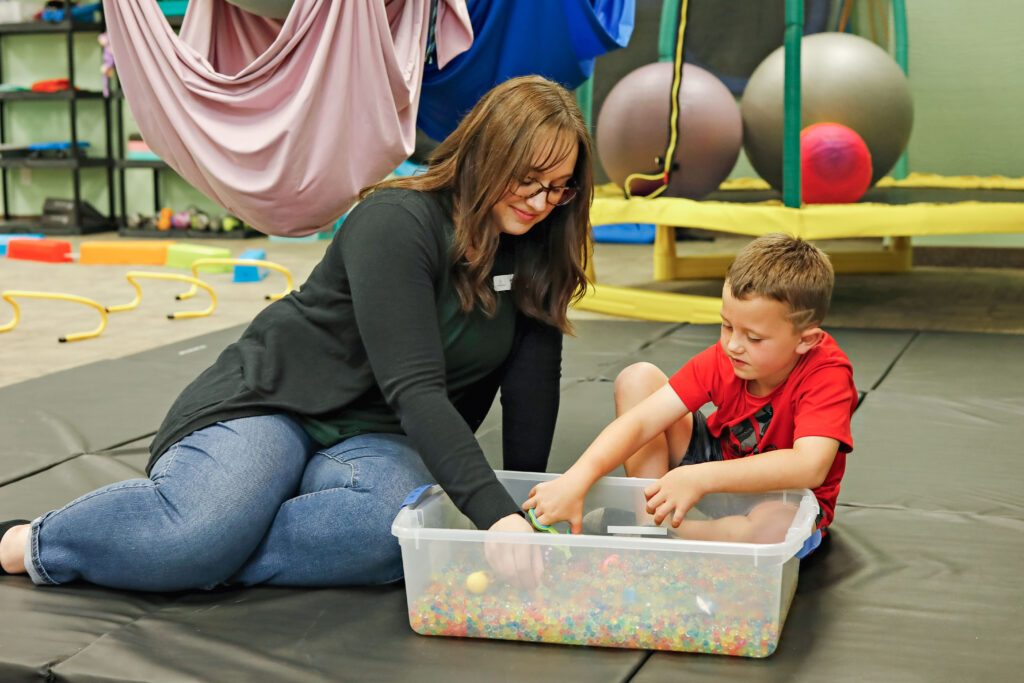
For instance, a therapist can start by strengthening the fundamental skills required for writing using puzzles, play dough, crafts, tongs, building toys, or climbing exercises rather than continuously practicing handwriting.
Obstacle courses, role-playing classroom activities, dressing practice, games, sensory exercises, and structured play are additional possible components of child school preparation treatment.
The therapist is thinking about the underlying skills the child needs to participate successfully rather than just asking, “Can this child complete a worksheet?”
The Significance of Kindergarten Fine Motor Readiness
Handwriting is just one benefit of having strong hands and well-coordinated fingers.
A child’s capacity to use scissors, handle educational materials, finish art projects, handle clothing, open food containers, and carry out numerous other routine classroom duties is impacted by their level of kindergarten fine motor preparedness.
Children may avoid or feel upset with fine motor exercises that need a lot more work than anticipated.
While maintaining age-appropriate and interesting exercises, Kindergarten preparedness OT Billings can address hand strength, bilateral coordination, visual-motor integration, grip patterns, and other fundamental competencies.
Facilitating the Kindergarten Transition
Starting school can cause anxiety in even kids with great developmental skills. The transition may seem more predictable if preparation is done gradually.
Some beneficial school transition assistance children could be:
- Setting up sleep and morning routines in advance for the school day
- Practice putting on a jacket and backpack
- Reading books about kindergarten entry
- -Working on opening lunchboxes
- Going to the school whenever you can
- Discussing what a normal school day may entail
- Short separations from caretakers are practiced.
- Using calendars or visual schedules
Instead of expecting every kid to prepare in the same manner, school transition help children received through OT can concentrate on the unique issues of children who require extra preparation.
When Should Early Childhood Occupational Therapy Be Considered?
Children grow at different rates, and a youngster may not require therapy if they struggle with a particular skill.
However, if difficulties persistently impede play, self-care, preschool involvement, family routines, or school preparation, a early childhood OT Billings MT consultation can be worthwhile.
In particular, parents might want to talk about an evaluation if their child:
- Avoiding fine motor activities on a regular basis
- Significantly struggles with dressing or using utensils
- Overwhelmed by ordinary sensory experiences
- Significant difficulty with transitions
- Participating in age-appropriate group activities is difficult for them.
- Delays are evident in several areas of development.
Additionally, a pediatrician can assist families in deciding whether occupational therapy, further screening, or another kind of developmental assistance is necessary.
Encouraging Your Child to Practice at Home
Preparing for school doesn’t have to feel like homework.
Preschool developmental milestones are organically strengthened by several daily activities. Block building improves coordination. Hand strength is enhanced by drawing. Turn-taking is introduced when playing board games. Dressing promotes self-reliance. Assisting with snack preparation offers chances to improve fine motor skills and follow instructions.
While letting kids learn through everyday family routines, these While letting kids learn through everyday family routines, these activities can supplement child school preparation therapy.
Additionally, parents can find out from their occupational therapist which activities best fit their child’s unique objectives.
A “Perfectly Ready” Kindergartner Is Not the Objective
It’s not necessary to tick every box to be prepared for kindergarten.
Some kids will write letters with confidence when they start school, but they still require assistance with transitions. Some will be self-assured in social situations but require extra assistance with their fine motor skills. Seldom does development occur uniformly in all areas.
Transforming children into elementary school students before their first day is not the goal of school readiness occupational therapy Montana. It’s to assist kids develop the fundamental abilities they require and to detect obstacles that might make regular school participation unduly challenging.
This implies that certain families can employ occupational therapy preschoolers prior to kindergarten. For others, basic at-home techniques and more practice might be sufficient.
Concluding Remarks: Is Your Child Prepared for Kindergarten?
The shift to kindergarten is significant, and being prepared requires much more than just knowing the ABCs and numbers. How well a kid navigates the classroom depends on a number of factors, including fine motor development, independence, attention, sensory management, social involvement, and emotional skills.
kindergarten preparedness OT Billings can assist you in determining areas where your child might need more assistance if you have any concerns. While earlier toddler developmental screening Billings can assist families in identifying possible issues well in advance of the first day of kindergarten, a child developmental evaluation Billings can offer a more comprehensive picture of developmental strengths and challenges.
Families can help children approach this joyful milestone with more freedom and confidence via developmentally appropriate practice at home, careful school transition support children, and early childhood OT Billings MT.
Perfection on the first day is not the aim. It’s providing your child with the abilities, encouragement, and chances they require to learn, engage, and develop once kindergarten starts.


No comment yet, add your voice below!