Holidays and Dysregulation

Holidays and Dysregulation

It’s that time of year where we are approaching the holiday season…and quickly at that! Halloween is around the corner followed closely by Thanksgiving and Christmas…where does the time go? At the clinic, we tend to see increased dysregulation during sessions as well as reports from caregivers of increased meltdowns at home. Holidays are a time when children and caregivers experience a high frequency of dysregulation. Between sugary treats, changes in routine, unexpected events, and the stress of shopping – it is very easy to enter “fight or flight mode.” Planning ahead and utilizing some simple strategies can make the holiday season enjoyable for everyone. 

You may be asking yourself, “what do you mean by dysregulation?” Regulation is our body’s ability to facilitate appropriate emotional responses given the demand of the situation. Some emotions we experience in a regulated state are: calm, focused, safe, and happy. When we are dysregulated, the intensity of our reaction does not match the situation. Some emotions we might experience are: anger, sadness, fear, irritability, and sensory overload. Does this sound familiar?  

Here are some strategies to keep everyone (caregivers included) as regulated as possible during the “seasonal stir” that our occupational therapists recommend at Little Legends Therapy.  


Practice visual, verbal, or mental rehearsal with your children:

Sticking to your typical routine during the holiday season can be difficult. Prepping children the night before and letting them know what to expect, rules, manners, and exit strategies can decrease anxiety for everyone. Letting them know where they are going, who will be there, and what time can allow them to visualize and ask questions beforehand. You can then walk them through any potential problems or questions they might have. Utilizing a visual schedule, this can be as simple as writing down the “plan” for the day on a sheet of paper with a pen, and crossing it off as you go. If there are any unexpected changes, you can add it to the plan! 


Come prepared:

Bringing tools with you to help keep your child regulated is essential. Whether your child is a picky eater, overwhelmed by loud environments, or cannot sit still at a table, there are tools to help. Here is a common list of items that can assist to calm your child’s nervous systems.

  • Gum and sugar free suckers
  • Crunchy snacks
  • Sucking large liquid through a straw (water bottles or smoothies)
  • Weighted lap pads or blankets 
  • Noise canceling headphones 
  • Stress balls (NeeDoh is amazing!)
  • Preferred toy 
  • Blowing bubbles (small bubble wands)


This includes coming prepared for long car rides if traveling. Make sure to bring preferred items, wearing comfy clothes, and let the drive be a time where everyone can “wind-down.”


Incorporate sensory input during the day: 

Incorporating 7-10 minutes of rhythmic and repetitive input every hour is the optimal amount of time required to keep our bodies in a regulated state. Below is a list of activities you can include throughout the week to maintain regulation. 

  • Jumping on a trampoline 
  • Swinging 
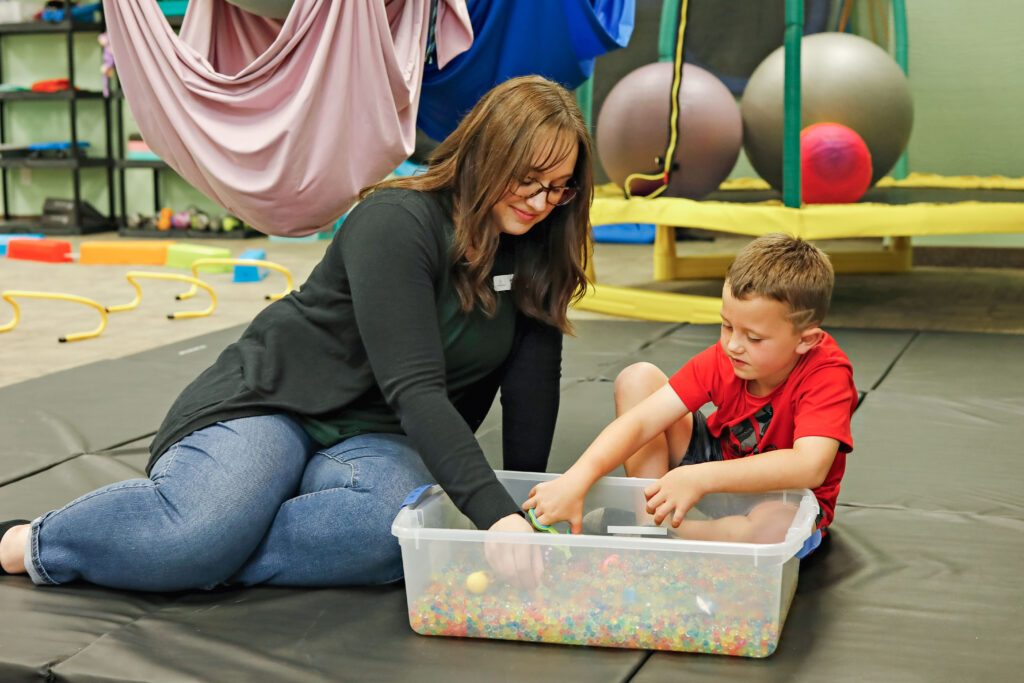
  • Playing with different media (kinetic sand, playdough, water beads, slime, rice, corn, etc). 
  • Making a “bubble tower”
  • Crashing onto pillows and blankets 
  • Listening to preferred music
  • Riding a bike or scooter 
  • Bouncing a ball
  • Rocking 
  • Walking
  • Yoga 
  • Repetitive crafts
    • Perler beads 
    • Coloring 
    • Drawing 
  • Have a “calm” space for kids to decompress in 


Have an exit plan:

When you arrive at a gathering or event, talk beforehand about when it is a good time to leave. You may notice an increased presence of behaviors due to fatigue, this may be a good time to leave to take a nap. You can come up with a hand signal or a phrase that indicates it is time to go. Make sure to honor how your child is feeling and be true to yourself about how you are feeling! 


Lower expectations: 

When children experience stress, you will notice a regression in their behavior. This could look like baby talk, difficulty following simple instructions, hyper-activity, and inability to complete their daily routine. It is important to meet your child where they are at until they can regulate and access the thinking part of their brain again. This might look like offering two choices or you completing 80% of the task while they finish the remaining 20%. Make sure your children know that it is always okay to ask for a break when needed. 


Parents and co-regulation: 

Parents often forget to think about their own self-care during this time of year. The stress of the holidays puts most adults in a dysregulated state and modeling this can impact children. It is important that parents schedule down-time for themselves into their day. This could be during nap time for littles and/or homework time. Simple things like reading, watching TV, exercise, and journaling are great ways to re-center. If you are modeling anxiety and stress, your child will follow suit. It’s important to remember your self-care and coping skills and practice them regularly. 


We hope that these strategies help your family successfully navigate the upcoming holiday season!  

Back to School Already? Tips and Tricks for a Smooth Transition

We can’t believe that it’s back to school already! We have had a lot of parents in the clinic this week coming to us with questions on how to prepare their children for the start of the school year. It’s never easy, but there are simple but effective strategies that can aid in decreasing behaviors and meltdowns for all parties involved. Below are our top 5 “tips and tricks” for a smooth transition back to school. 

  1. Front load – this is a technique inclusive of over preparing your child for what is to come by taking your child through all the steps when they are regulated. This may look like placing a calendar in their room or in the kitchen with a sticker that says “back to school” on it. Let them know what day they are starting, who their teacher is, and what time they are getting up at. Start the weekend before their first day and remind them once every night. You can use pictures as visual aides or talk them through their first day by practicing mental imagery!
  2. Set a routine – routine and consistency are beneficial for everyone. Making sure to set a predictable before, during, and after school routine can allow your child to know what to expect!
  3. Visual schedules – this can be on a white board at home with pictures or written on a piece of copy paper. This allows children to know what comes next. For those who are “inflexible” thinkers, you can utilize the visual schedule for any change by switching out activities. 
  4. Lower expectations – changes in routine and going to school can be stressful for children and their nervous systems. This might look like emotional outbursts, increased fatigue, and “lashing out” type behaviors. Lowering expectations and meeting your child where they are at will help them feel successful and build confidence while they transition to something new. This might look like limiting your language to simple “first then”.Lowering a 3-step directive to a 2-step directive. Having them complete 10% of the task with you completing the remaining 90% until their nervous system is regulated and they are into a routine. For example, when picking up their toys, you will clean up all but the last 2. 
  5. Regulation is key – incorporating regulation into your child’s schedule before, during, and afterschool can prevent their nervous system from going into “fight, flight, or freeze” modes. I know it’s hard to remember but, incorporating regulation into your schedule as a parent is important to allow for positive co-regulation and modeling for your child. Below is a list of regulation tools and activities for your child to utilize before, during, and after school! 
  1. Swinging 
  2. Jumping
  3. Bubble towers 
  4. Repetitive movement through “messy hands” activities
    1. Water beads
    2. Kinetic sand
    3. Slime 
    4. Rice 
    5. Beans 
    6. Playdough 
    7. Shaving cream
  5. Riding a bike
  6. Noise canceling headphones 
  7. Fidgets (Nee Doh has some great options that are less distracting) 
  8. Snacks (crunchy, gum, sugar free suckers, thick liquids through straws, etc.) 
  9. Weighted lap pads (school) or weighted blankets (home)
  10. Chewelry (necklaces, bracelets, pencil toppers, etc.) 
  11. Quiet corners or tents with low sound and lighting 
  12. Blowing bubbles 
  13. Music (metronome app set at 60-80 beats per minute or preferred calming songs)
  14. Bouncing a ball 
  15. Rhythmic and repetitive craft activities (diamond dots, perler beads, coloring, etc.)

Animal Assisted Therapy

Animal Therapy

If you have been following our social media accounts, then you may have noticed a lot of “furry
friends” popping up on our feed lately! We have been incorporating dogs into our sessions in a
variety of ways this summer, more than your average “animal assisted therapy”. Tenika, CEO of
Little Legends Therapy, met Camilla (CEO of Blue Creek Canine) when she was training
Tenika’s wild corgi, Winston. During one of their sessions, Camilla expressed interest in utilizing
trained therapy dogs to help motivate clients to complete their tasks during their occupational
therapy sessions. The dog would be utilized in a “functional” sense rather than for
“co-regulation” purposes. Camillia and Tenika were both curious if integrating a dog into
sessions would increase motivation and participation during their sessions, therefore, improving
their functional skill levels and success across various environments! Over the past 5 weeks,
they have trialed dog assisted therapy with three OT clients and seen wonderful results! Murphy,
a certified animal assisted therapy dog, has assisted the clients in developing gross motor skills,
visual motor skills, fine motor skills, executive functioning skills, impulse control, and sensory
processing skills throughout each client’s sessions. Some of the interventions they completed
together are: obstacle courses, yoga, therapeutic brushing, handling dog food, completing fine
motor dog puzzles, multi-step following directions tasks, and many more! Little Legends and
Blue Creek Canine will complete their interventions through summer and look at pre/post test
measures to determine the effect Murphy has had on the clients progress. Parents have
reported increased motivation to attend therapy and therapists have noted improvement in
attention and impulse control for the duration of their sessions. If positive results continue to be
seen, they will begin to implement more dogs into clients sessions who are interested!
Little Legends has found one other way to utilize animals into therapy sessions with their
teenage clients. Many teenagers with social skill differences and high anxiety have very little
that motivates them to get out of the house and try new things, which can make it difficult to
build the skills they need to be successful at school, post graduation, and at home. Upon
discovering animals were a common area of interest for this population, it was decided to reach
out to a local non-profit here in town, Pooch’z B&B, a company who houses senior dogs who
can no longer be cared for by their owners. Little Legends set-up a 1:1 session with a
16-year-old client to spend 2 hours volunteering together with the overall goal to increase
success in ADL’s and IADL’s by building skills such as responsibility, time management,
executive functioning, social interaction, and many more. So far, they have completed tasks
such as yard maintenance, walking dogs, washing dog bowls, gardening, and grooming all while
hanging out with 20+ dogs! It’s been fun and rewarding at the same time and our client has
made huge progress!
If you are interested in animal assisted sessions for your child, please email us at
littlelegendstherapy.mt@gmail.com

Clinic announcements:

  • Eden Davis, Tenika’s previous student, has been hired and will begin as an OT aide in
    August. She graduates from her Doctoral Program in November and will begin taking
    clients full-time in November.
  • Please let your therapists know if you have any remaining vacations before summer
    ends!
  • We are STILL hiring! Yes, if you know anyone who is interested in joining the Little
    Legends Therapy team, we are looking to hire a full or part-time therapist. Visit our
    “careers” page to apply!